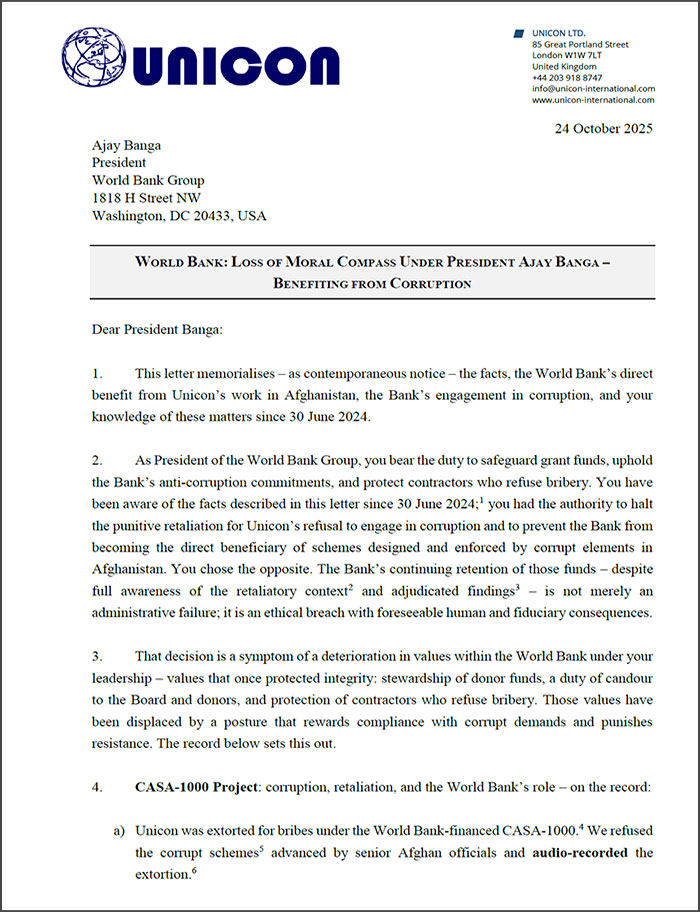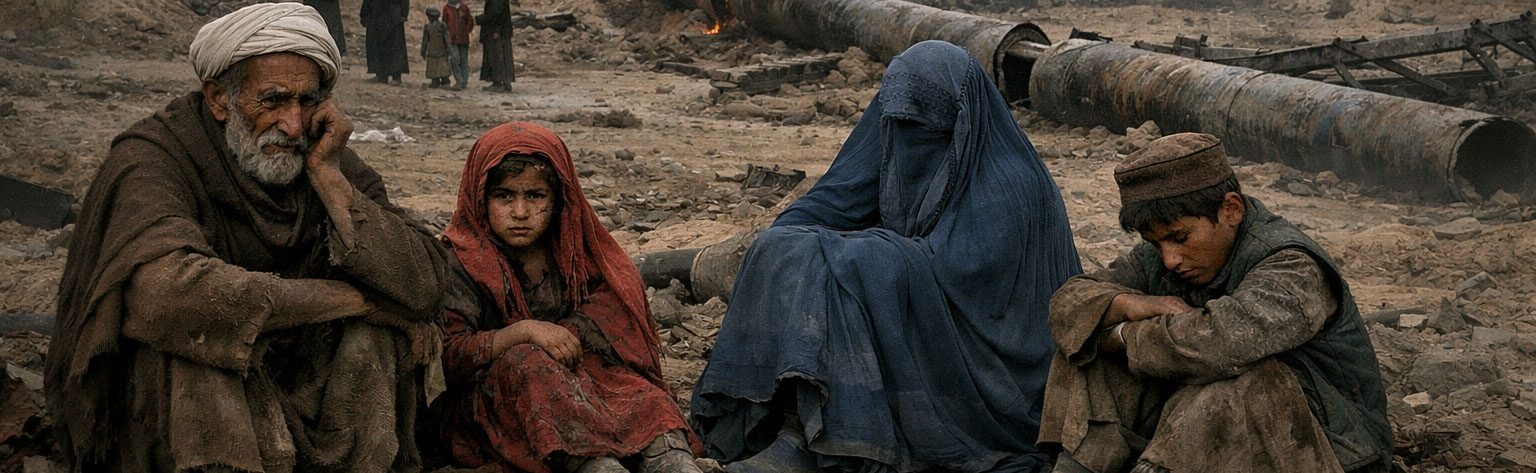
Unicon Ltd., a British contractor, lays bare a disturbing story from two World Bank-financed projects in Afghanistan – CASA-1000 and the Gas-to-Power project – both now before U.S. judges in Washington, D.C.
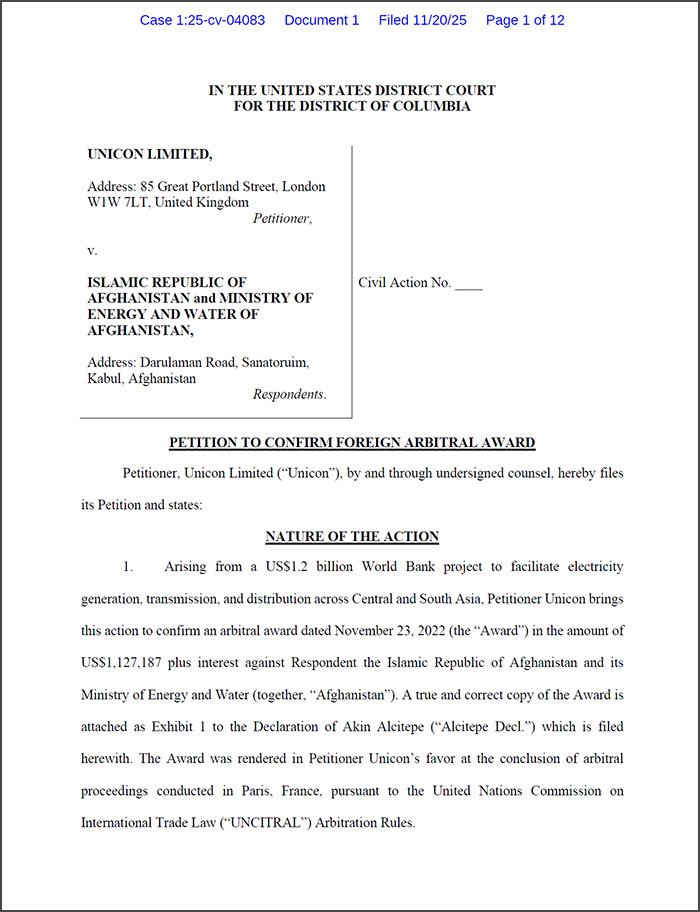 CASA-1000 Project
District of Columbia District Court
Case: 1:25-cv-04083
Judge: Carl J. Nichols
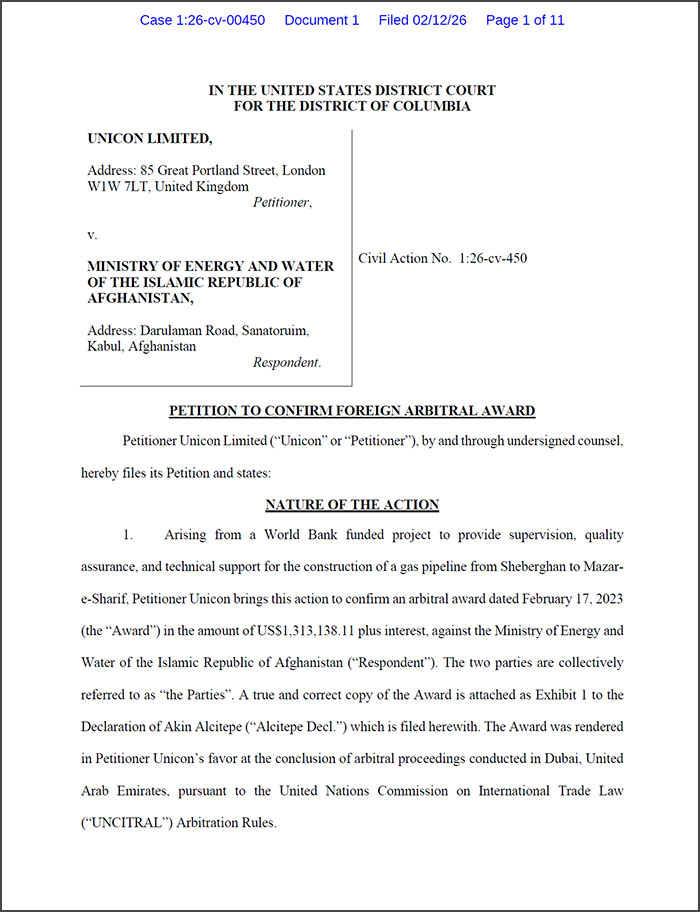 Gas-to-Power Project
District of Columbia District Court
Case: 1:26-cv-00450
Judge: Christopher R. Cooper
On both projects, senior Afghan officials demanded bribes. Unicon refused, audio-recorded the extortion, and reported it. What followed was deliberate financial retaliation: payment for work already delivered was withheld to make bribery seem like the lesser loss. Unicon did not yield.
Two independent international arbitration tribunals – one ICC, one PCA – examined the facts and ruled in Unicon’s favour, finding extortion and ordering immediate release of funds. These are not mere allegations. They are adjudicated outcomes reached through formal legal proceedings. Yet as Unicon pursued its remedies, corrupt Afghan officials diverted the unpaid sums to the World Bank, leaving the Bank to decide what to do next.
That is where the story becomes extraordinary. Because the projects were financed by World Bank grants rather than loans, the withheld payments did not remain in Afghanistan – they flowed back to, and remained with, the World Bank itself. The Bank therefore ended up in the most compromising position imaginable: it consumed Unicon’s work product, relied on those deliverables to sustain project activity, and retained money that international tribunals had ordered released. The Bank’s own written communications – praising Unicon’s “amazing, incredible work” and explicitly promising compensation – make its subsequent refusal to pay a documented breach of its own commitments.
Addressed personally to World Bank President Ajay Banga and copied to senior U.S., U.K., and Bank executives, the Detailed Letter, backed by documentary evidence, is not a plea for investigation. It reads as a documented case of institutional failure at the highest level. Its central claim is stark: Unicon refused corruption, documented it, proved it, and won – and the World Bank’s response was to retain the fruits of that integrity while offering none of the protection it promised. The Bank did not merely fail to stop the corrupt scheme. After full notice of the facts, and even after arbitral rulings ordering release of funds, it became the institutional beneficiary of it – retaining the money, consuming the work product, and preserving the very result that bribery and retaliation were designed to achieve.
That is what puts the World Bank in a graver moral position than the Afghan officials themselves: they initiated the extortion, but the Bank – armed with knowledge, authority, and an anti-corruption mandate – chose to preserve its fruits. With arbitral rulings, internal records, and audio recordings behind it, this is not just a complaint. It is a record of the World Bank’s moral collapse, and it demands to be read.
_____________________
Documents: